Subnautica 2 Guide: All Resources and Materials List
Stop Swimming in Circles and Find Every Crafting Material on Zazura With This Complete Harvesting Guide

Quick Answer: Resources on Zazura are split into Inorganic Materials, Flora and Fauna, and Salvage. To kickstart your progression, prioritize harvesting Raw Ore nodes for a steady supply of Titanium, Copper, and Quartz, slice cave plants for Fibrous Pulp, and collect orange glowing Lucifer Rotsacs to manufacture Rubber.
Dropping to the ocean floor of planet Zazura without a plan is a quick way to stall your progress. The seabed is absolutely loaded with exotic minerals and strange alien life, but the game does very little to show you where they hide. You can easily spend hours swimming in aimless circles searching for a specific component, completely unaware that it was hanging right above your head on a dark cave ceiling.
Unlocking advanced submersibles and building a sprawling underwater base requires a deep understanding of the local ecosystem. Here is a complete breakdown of every resource currently available in Early Access, where to harvest them, and what they actually build.
Inorganic Resources (Minerals and Ores)
Inorganic resources form the structural backbone of almost every piece of high-tech gear, oxygen tank, and vehicle upgrade you will craft. The most efficient way to farm baseline metals is by hunting for Raw Ore nodes. Breaking these nodes down at your Fabricator yields Titanium, Copper, and Quartz all at once.
When searching for individual deposits, look for Titanium scattered as loose rocks across the shallow seafloor. Copper grows almost exclusively along the tight walls and ceilings of deep underwater caves. Quartz can be found nestled inside massive orange coral formations, which are incredibly easy to spot at night because they emit a bright, ambient glow.
Beyond those basic materials, you will need to stockpile rare elements as you explore deeper biomes.
| Mineral / Resource | Key Fabricator Crafting Uses |
| Atacamite | Axum Interface Chip, Echo Location, Mangalloy Ingot, Ultra High Capacity Air Tank |
| Axum Bacterial Culture | Metal Form |
| Celestine | Axum Pot, Axum Street Lamp, Modification Station, Strontium, Tadpole Depth Module Mk. 1 |
| Conduit Crystal | Advanced Battery, Bioscanner, Entangled Power Cell, Feedback Resonator, Improved Fins |
| Crab Feces | Biofuel Block |
| Creature Enamel | Enameled Glass |
| Cyan Pigment | Cyan Glowstick |
| Deepwing Egg Clump | Axum Etching Acid, Pavlova |
| Gold | Advanced Wiring Kit, Gold Ingot, Thermal Plant, Silver refinement, Strong Acid |
| Lead | Sonic Resonator, Sugar of Saturn |
| Lithium | Current Ring, Lithium Grains, Plasteel Ingot, Portable Oxygen Generator |
| Pent | Biofuel Block, Mild Acid |
| Prismatic Shell | Mineralized Water Tablet, Powdered Shell |
| Salt | Glass, Halfmoon Jerky, Isotonic Water, Nutrient Block, Power Cell, Power Storage, Tailing Jar |
| Sulfur | Advanced Wiring Kit, Heat Resistance Chip, Repair Tool, Strong Acid |
| Troilite | Entangled Power Cell, Mangalloy Ingot, Photovoltaic Charger, Tadpole Depth Module Mk. 2 |
Gold is arguably the most versatile mid-game mineral on Zazura. Beyond its direct use in high-end electronics like Advanced Wiring Kits, you can process Gold into Silver or mix it with Sulfur to brew Strong Acid. Stockpile every gold deposit you stumble across.
Flora and Fauna (Organic Materials)
Organic resources are harvested directly from the living inhabitants of the ocean. Some materials are sliced from stationary alien plants, while others are collected from creature drops or biological byproducts.
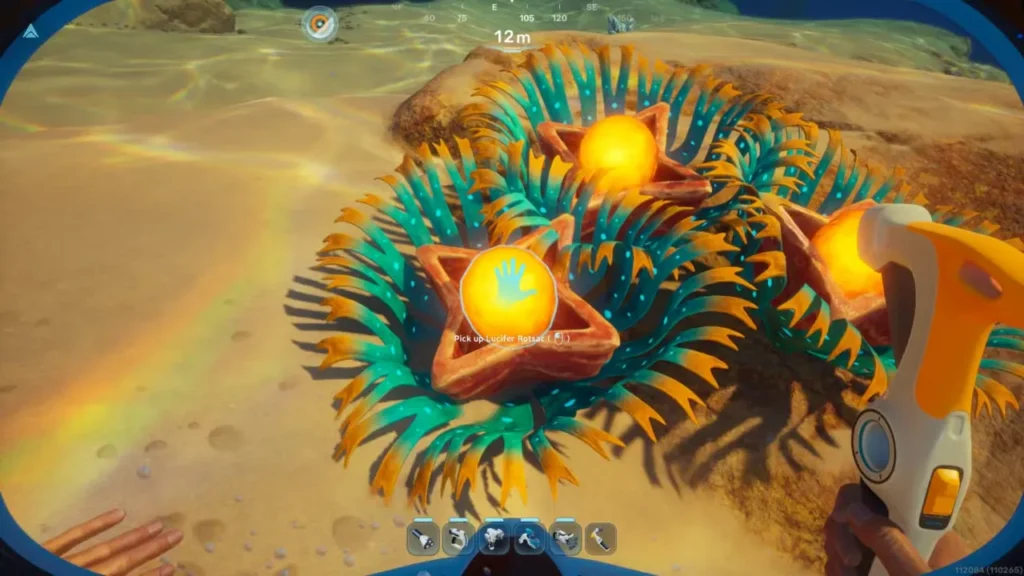
For early-game survival, Fibrous Pulp is incredibly vital. You can harvest it in bulk from Curtain Gorgon mushrooms and dark pink Feather Kelp inside shallow caves. It acts as a baseline ingredient for crafting clothes, fuel, and survival rations. If you want to build advanced baseline tools, you will also need to hunt for Lucifer Rotsac. This is a bright orange, glowing organism found attached to the seafloor, and it serves as the game’s only source of Rubber.
To stay healthy during dangerous expeditions, keep an eye out for Medical Gel Sacs to craft healing kits, and grab Acidic Raion Pouches to keep your tools powered.
Before you go hunting for these organic materials in dangerous territories, make sure you know exactly how to clear Bloom Infestations in Subnautica 2 because these aggressive root zones often block access to the richest harvesting grounds.
| Organic Resource | Key Fabricator Crafting Uses |
| Acidic Raion Pouch | Basic Battery, Mild Acid |
| Cherimaya Rotsac | Cherimoya Chutney, Pavlova |
| Coral Shavings | Coral Jar, Coral Mash, Small Coral Jar |
| Fibrous Pulp | Alcohol, Biofuel Block, Fiber, Water, Mimic Pylon, Threemoon Temaki |
| Flash Slug | Isotonic Water |
| Halfmoon | Cooked Halfmoon, Grease, Halfmoon Jerky, Threemoon Temaki |
| Harvestmoon | Cooked Harvestmoon, Macaron Crisp Tesst, Threemoon Temaki |
| Hoverthorn | Cooked Hoverthorn, Hoverthorn Souvlaki |
| Lucifer Rotsac | Cradle Shootroot, Floating Support, Glowstick, Grease, Rubber (Requires 2x Lucifer Rotsac) |
| Macaron Lining | Macaron Crisp Tesst |
| Medical Gel Sac | Acid Raion, Enhanced First Aid Kit, First Aid |
| Necrolei Cyst | Strong Acid |
| Water Slug | Biosampling Kit, Mineralized Water Tablet, Water |
Be careful not to over-farm your immediate surroundings. Certain organic items have much slower population recovery rates than standard minerals. If you completely drain a nearby cave system of its Medical Gel Sacs or Lucifer Rotsacs, it will take a long time for them to return. Rotate your foraging locations across different biomes to give the local wildlife time to replenish.
Salvage and Debris
Salvage represents the scraps of wreckage and shattered mechanical debris littered across the planet. While it is currently the smallest item classification in the game, it provides an excellent safety net when natural ore deposits run thin. Frying Metal Salvage inside your Fabricator breaks it down into Salvaged Titanium, ensuring you never run completely out of basic structural materials.
| Salvage Type | Crafting Utility |
| Metal Salvage | Salvaged Titanium |
| Axum Resonator | No current use (Placeholder) |
| Biobed Capsule | No current use (Placeholder) |
Items to Save for Future Patches
Because Subnautica 2 is actively developing in Early Access, there are several items scattered across the world that you can physically scan and collect, but they do not feature an active crafting recipe yet. Do not throw these away if your inventory gets tight. Stash them inside a base storage locker instead, as future content updates will likely activate their blueprints.
- Aeroshell Sponge
- Algae Block
- Axum Etching Acid
- Cooked Pneuma
- Houndgar
- Oxygen Bottle
- Pneuma
- Quadrate
- Sandspear
- Shiver Leviathan samples
Unlocking New Blueprints
Simply stuffing your pockets with alien minerals will not magically teach your Fabricator how to use them. To unlock new crafting recipes, you must pull out your handheld Scanner and manually analyze every new object you pick up or discover in the wild. Prioritize scanning every strange plant, unique crystal node, and creature byproduct you encounter. Many of the game’s most powerful blueprints are completely hidden until you scan their core components for the first time.
Materials You Should Prioritize First
If you are just starting your adventure, focus your early storage space on these six foundational resources to ensure you do not hit a sudden progression wall:
- Raw Ore: Gives you Titanium, Copper, and Quartz from a single source.
- Fibrous Pulp: Keeps you fed, hydrated, and supplied with basic equipment fibers.
- Acidic Raion Pouch: The primary ingredient needed to build basic batteries for your flashlights and scanners.
- Salt: Crucial for preserving fish into long-lasting rations and manufacturing advanced power cells.
- Lucifer Rotsac: Safely gates your progress until you use it to manufacture Rubber for basic tools.
- Sulfur: Mandatory for building your first Repair Tool and crafting advanced electronic wiring kits.